Fits single-level latent profile models with each number of profiles in
n_profiles under each covariance structure in model, and returns them
in one table for comparison by information criteria, entropy and the
diagnostics of each fit. It is enumerate_classes() with id = NULL, and
it returns the same object.
Arguments
- data
A data frame with one row per observation.
- vars
Names of the indicator columns.
- n_profiles
Positive whole numbers of profiles to compare.
- model
The covariance structures:
"basic", the default, for the four that combine equal or varying variances with covariances absent or present (EEI,VVI,EEE,VVV);"all"for all 14; or their three-letter codes. Seeenumerate_classes().- ...
Further arguments for
multilpa(), such asmissing,n_starts,seedandcategorical, exceptidandn_group_classes.
Value
An object of class multilpa_enumeration, as enumerate_classes()
returns: as.data.frame() gives one row per candidate, summary() the
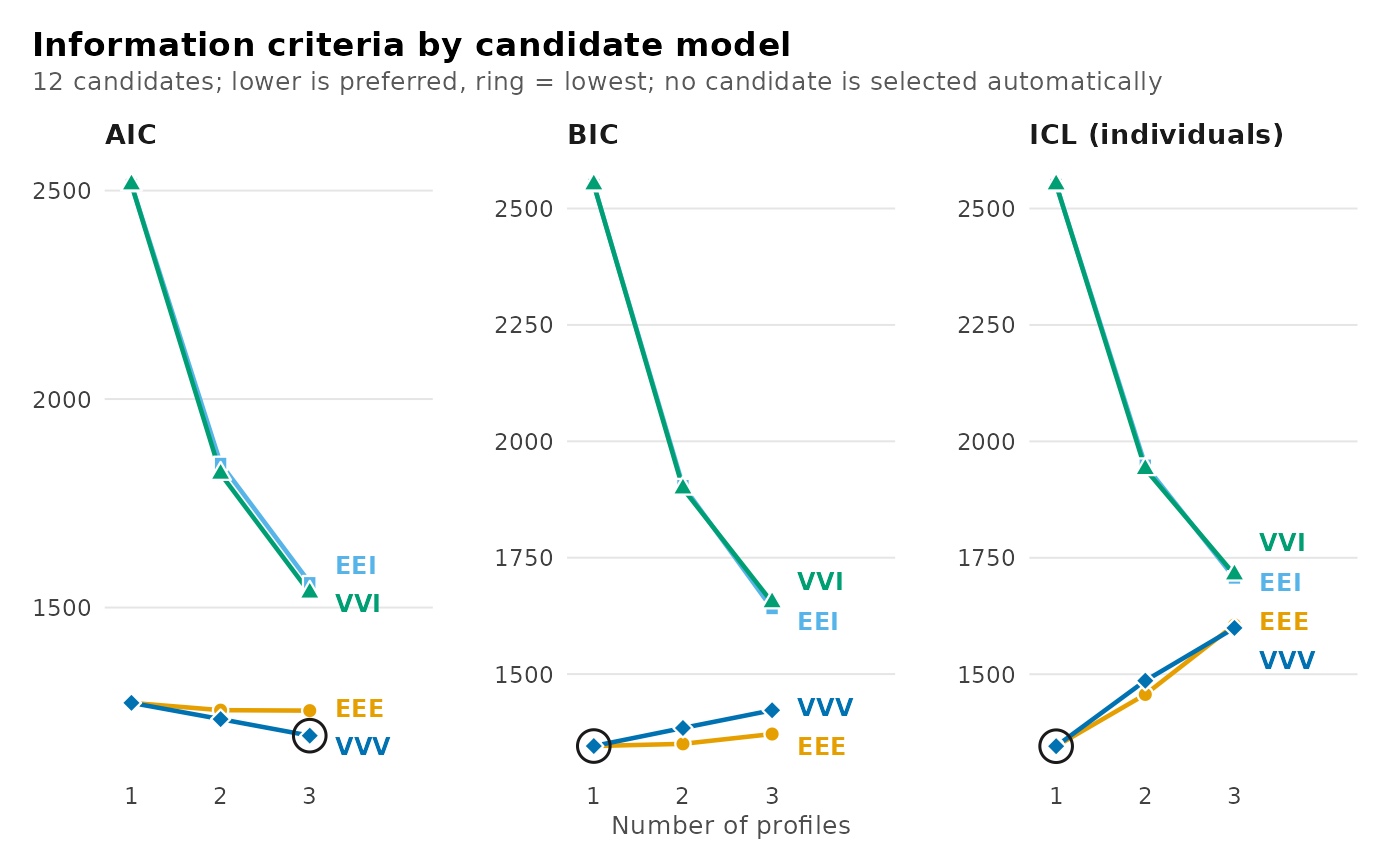
candidate each criterion prefers, plot() the criteria against the
number of profiles, and candidate_fit() one fitted candidate.
Details
For observations nested in groups, use enumerate_classes() with the
grouping column as id, which also crosses the number of group classes.
Conditions
latents_bad_argument when id or n_group_classes is passed, or when
model names an unknown structure.
References
Celeux, G., & Govaert, G. (1995). Gaussian parsimonious clustering models. Pattern Recognition, 28(5), 781–793.
See also
lpa() to fit one model; enumerate_lca() for categorical
indicators; bootstrap_lrt() to test one number of profiles against
another.
Examples
models <- enumerate_lpa(srl, c("cognitive_strategies", "intrinsic_value",
                               "self_efficacy", "self_regulation",
                               "test_anxiety"),
                        n_profiles = 1:3, n_starts = 2, seed = 1)
summary(models)
#> Class enumeration: 12 candidates, 12 converged, 0 failed to fit
#> 2 distinct candidate(s) are minimal under some criterion.
#> No candidate is selected automatically. Choose one convention and keep it.
#> The candidates table shows 10 of its 26 columns; get_results(x, what = "candidates") returns all of them.
#>
#> -- candidates ------------------------------------------------------
#>  n_profiles model log_likelihood n_parameters  aic  bic icl_individual
#>           1   EEI        -1247.3           10 2515 2552           2552
#>           2   EEI         -906.7           16 1845 1905           1949
#>           3   EEI         -757.7           22 1559 1641           1707
#>           1   VVI        -1247.3           10 2515 2552           2552
#>           2   VVI         -889.3           21 1821 1898           1940
#>           3   VVI         -735.7           32 1535 1654           1714
#>           1   EEE         -615.7           20 1271 1345           1345
#>           2   EEE         -600.9           26 1254 1350           1457
#>           3   EEE         -594.4           32 1253 1371           1606
#>           1   VVV         -615.7           20 1271 1345           1345
#>  profile_entropy converged boundary
#>               NA      TRUE    FALSE
#>           0.8939      TRUE    FALSE
#>           0.9003      TRUE    FALSE
#>               NA      TRUE    FALSE
#>           0.8991      TRUE    FALSE
#>           0.9089      TRUE    FALSE
#>               NA      TRUE    FALSE
#>           0.7440      TRUE    FALSE
#>           0.6442      TRUE    FALSE
#>               NA      TRUE    FALSE
#>    ... 2 more rows.  get_results(x, what = "candidates")
#>
#> -- criteria --------------------------------------------------------
#>  criterion  convention n_profiles n_group_classes model value
#>        aic        <NA>          3               1   VVV  1193
#>        kic        <NA>          3               1   VVV  1258
#>        bic      groups          1               1   EEE  1345
#>        bic individuals          1               1   EEE  1345
#>      sabic      groups          3               1   VVV  1226
#>      sabic individuals          3               1   VVV  1226
#>       caic      groups          1               1   EEE  1365
#>       caic individuals          1               1   EEE  1365
#>        awe      groups          1               1   EEE  1520
#>        awe individuals          1               1   EEE  1520
#>    ... 4 more rows.  get_results(x, what = "criteria")
#>
#> 2 tables above, truncated to fit. get_results(x, what = ) returns any
#> of them whole, and get_results(x, what = "all") returns every one.
plot(models)