Constructs higher-order De Bruijn graphs from sequential trajectory data and selects the optimal Markov order using AIC, BIC, or likelihood ratio tests.
Arguments
- data
A data.frame (rows = trajectories, columns = time points), a list of character/numeric vectors (one per trajectory), a
tnaobject, or anetobjectwith sequence data. Fortna/netobject, numeric state IDs are automatically converted to label names.- max_order
Integer. Maximum Markov order to test (default 5). Must be a whole number; a non-integer value (e.g.
2.7) is an error rather than being silently truncated. Amax_orderat or above the longest trajectory is capped at (longest path - 1) with a message.- criterion
Character. Model selection criterion:
"aic"(default),"bic", or"lrt"(likelihood ratio test).- lrt_alpha
Numeric. Significance threshold for LRT (default 0.01).
- x
For the
print()andplot()methods: an object of classnet_mogen.- ...
In
plot.net_mogen(): Additional arguments passed toplot. Inprint.net_mogen()andsummary.net_mogen(): Additional arguments (ignored).- object
For the
summary()method: an object of classnet_mogen.- type
Character. Plot type:
"ic"(default) or"likelihood".
Value
An object of class c("net_mogen", "cograph_network") with
components:
- optimal_order
Selected optimal Markov order.
- criterion
Which criterion was used for selection.
- orders
Integer vector of tested orders (0 to max_order, after any capping).
- aic
Named numeric vector of AIC values per order.
- bic
Named numeric vector of BIC values per order.
- log_likelihood
Named numeric vector of log-likelihoods.
- dof
Named integer vector of cumulative DOF per model.
- layer_dof
Named integer vector of per-layer DOF.
- transition_matrices
List of row-stochastic transition matrices (index 1 = order 0, held as the marginal named numeric vector).
- count_matrices
List of the matching raw count matrices, same indexing; read by
mogen_transitions().- states
Unique first-order states.
- n_paths
Number of trajectories.
- n_observations
Total number of state observations.
- weights
cograph_networkweight matrix: the transition matrix of the selected optimal order (a 1 x n matrix named"marginal"when the optimal order is 0). Its dimnames are the internal k-gram keys (states joined by a non-printing separator), not arrow notation.- nodes
data.frame (
id,label,name) of the optimal-order De Bruijn nodes.- edges
cograph_networkedge data.frame with integerfrom/tonode indices and a numericweight. The readable arrow-notation table ismogen_transitions().- directed
Logical. Always
TRUE.- n_nodes, n_edges
Counts for the optimal-order graph.
- meta
cograph_networkmetadata list.- node_groups
Always
NULL.
In print.net_mogen() and plot.net_mogen(): The input object, invisibly.
In summary.net_mogen(): A per-order model-selection data.frame with columns order, layer_dof, cum_dof, loglik, aic, bic, best ("AIC"/"BIC"/"AIC+BIC" marker) and selected ("<--" on the chosen order), returned visibly; the summary text is printed as a side effect.
Details
At order k, nodes are k-tuples of states and edges represent transitions between overlapping k-tuples. The model tests increasingly complex Markov orders and selects the one that best balances fit and parsimony.
References
Scholtes, I. (2017). When is a Network a Network? Multi-Order Graphical Model Selection in Pathways and Temporal Networks. KDD 2017.
Gote, C., Casiraghi, G., Schweitzer, F., & Scholtes, I. (2023). Predicting variable-length paths in networked systems using multi-order generative models. Applied Network Science, 8, 68.
Examples
seqs <- list(c("A","B","C","D"), c("A","B","C","A"), c("B","C","D","A"))
mg <- build_mogen(seqs, max_order = 2)
# \donttest{
trajs <- list(c("A","B","C","D"), c("A","B","D","C"),
c("B","C","D","A"), c("C","D","A","B"))
m <- build_mogen(trajs, max_order = 3)
print(m)
#> Multi-Order Generative Model (MOGen)
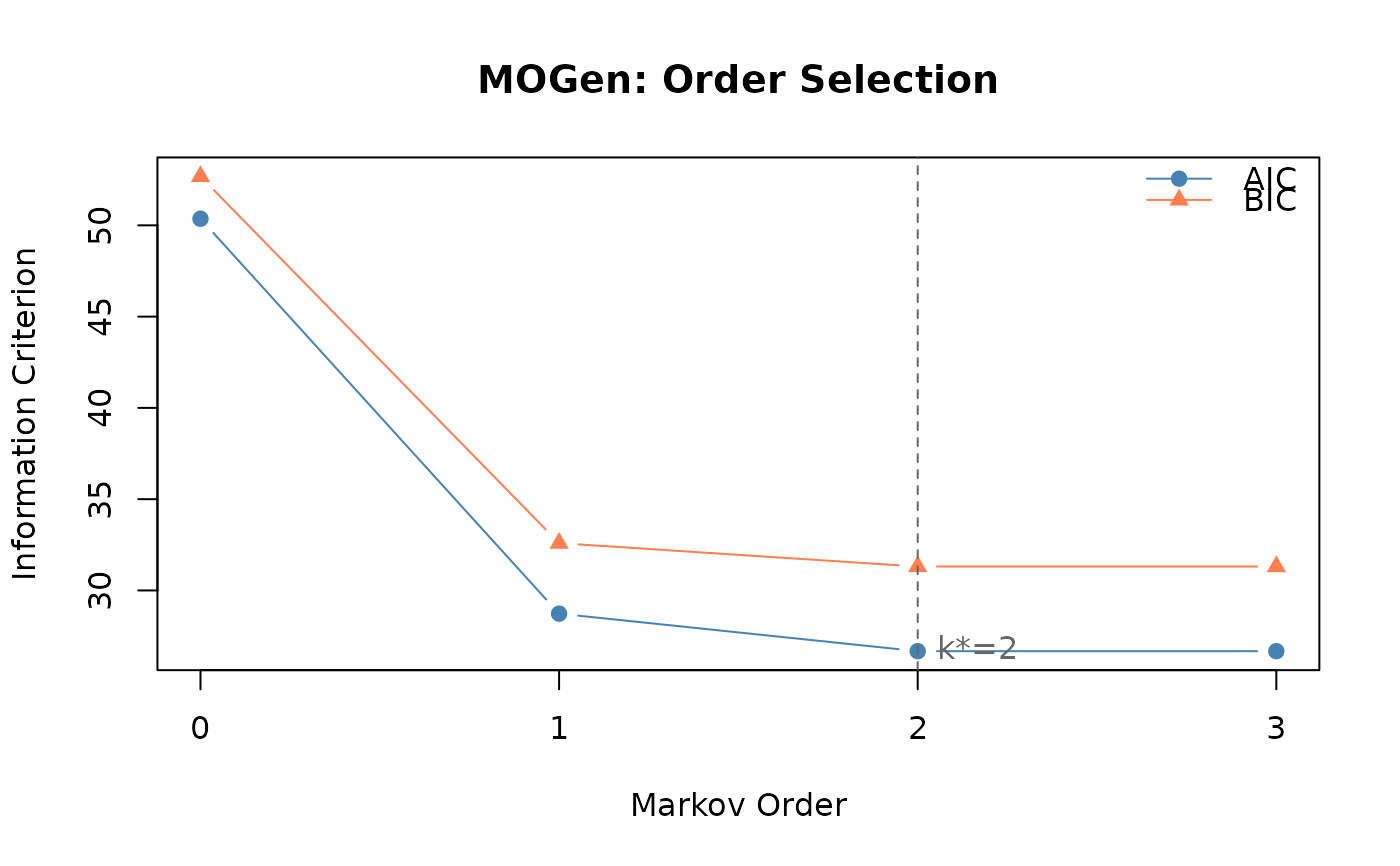
#> Optimal order: 2 (by aic)
#> Orders tested: 0 to 3
#> States: 4
#> Paths: 4 (16 observations)
#> AIC: 50.4 | 28.7 | 26.7* | 26.7
#> BIC: 52.7 | 32.6 | 31.3* | 31.3
#> (* = minimum; AIC and BIC agree on order 2)
plot(m)
 # }
# }