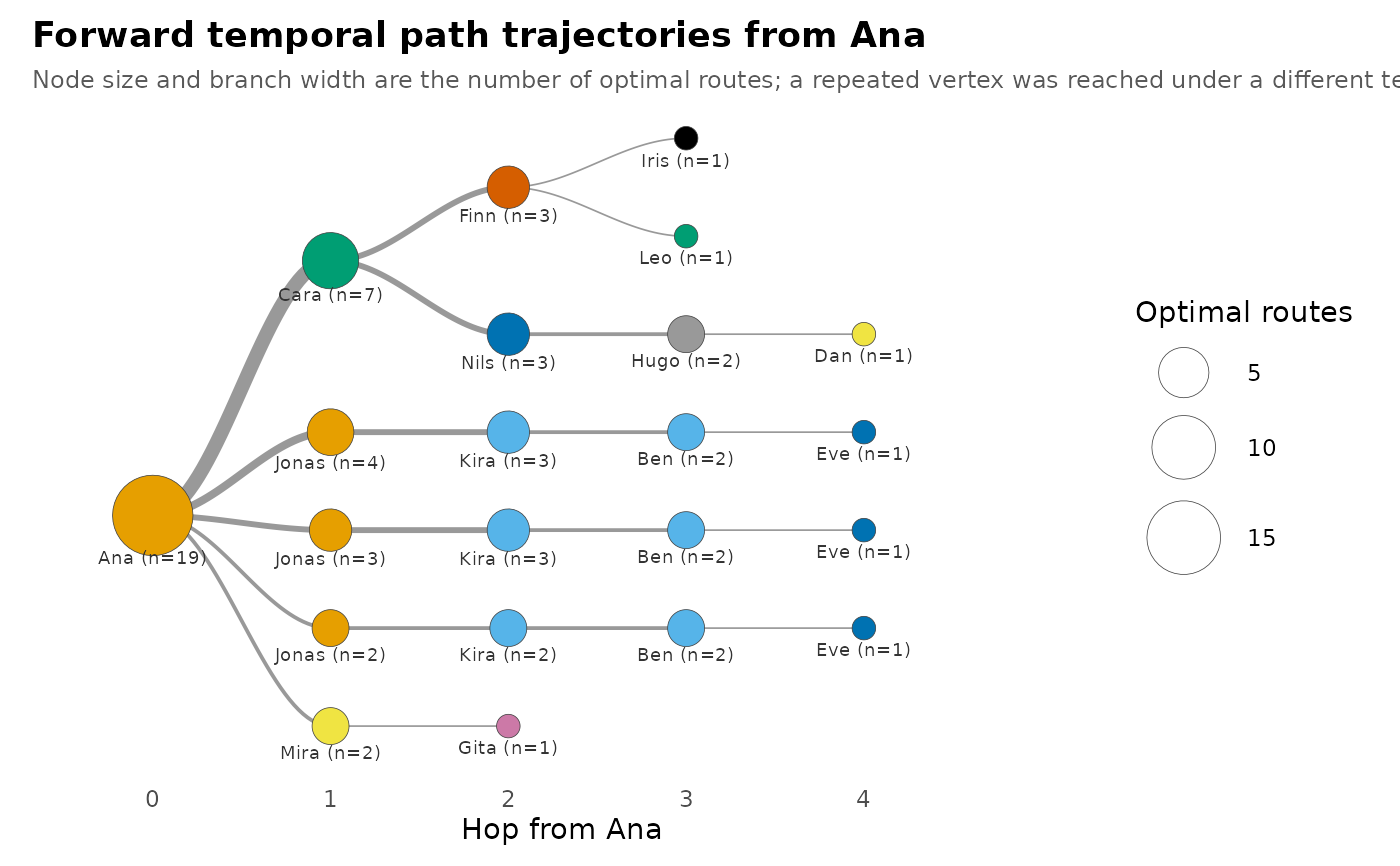
A result from paths() records the optimality criterion it was found
under, and such a result is drawn as a trajectory tree by
plot_path_trajectories(). That is the right picture for an
endpoint-local family: the routes need not share prefix-optimal
subpaths, so a vertex reached under two different temporal histories
appears twice rather than being forced into one predecessor tree.
Older serialised results carry no criterion. Those are drawn by the legacy
predecessor-tree renderer, which only defines a tree when the sessions were
collapsed; a bounded or separate-session result of that vintage raises
dynet_unsupported_plot instead of implying a tree the criterion never
promised.
Usage
# S3 method for class 'dynet_paths'
plot(x, palette = "okabe", ...)
Arguments
- x
A
dynet_pathsfrompaths().- palette
Palette specification, as in
plot.dynet(). Vertices are coloured by how many hops they are from the source. Read only by the legacy tree renderer.- ...
Passed to
plot_path_trajectories(), or tocograph::splot()for a legacy result.
Value
A ggplot object for a result carrying criterion metadata, which
is every result paths() returns. A legacy result without it is drawn on
the current device by cograph::splot() and x is returned invisibly.
A legacy result raises dynet_unsupported_plot when its sessions were
not collapsed, dynet_empty_result when the source reaches no other
vertex, dynet_bad_palette for an unusable palette, and
dynet_needs_cograph when cograph is not installed.