For a clustered hypergraph, ranks each cluster's hyperedges – on a
nodes = "doc" text_hypergraph(), its words – by one of four scores
computed from the hypergraph, or by a score table supplied from another
fit. This is the topic-description step that turns a partition from
hg_cluster() into named topics.
Usage
hg_keywords(
  hg,
  clusters,
  n = 10L,
  type = NULL,
  sort_by = c("score", "share"),
  min_docs = 1L,
  centrality = c("pagerank", "clique", "Z", "H"),
  scores = NULL,
  collapse = FALSE
)

# S3 method for class 'hypergraphs_keywords'
print(x, ...)

# S3 method for class 'hypergraphs_keywords'
plot(x, value = c("score", "share"), label = TRUE, ncol = NULL, ...)
Arguments
- hg
The hypergraph the clustering was computed on, or the sentence hypergraph of the same documents (see Sentence scope).
- clusters
The tidy table returned by
hg_cluster()(columnsnode,cluster), a named vector of cluster labels, or the name of a column of the hypergraph's document table, so a group variable of the corpus such as"period"gives its words directly.- n
Keywords per cluster (default
10);Infreturns all.- type
Which score ranks the words: any of
"mass","frequency","ctfidf","centrality". Several at once give one block of rows per score. Default"mass", or none when onlyscoresis wanted.- sort_by
"score"(default) ranks a cluster's words by the selected score, the heavy vocabulary;"share"ranks them by the fraction of the word's total score that falls in the cluster, the distinctive vocabulary. Ties are broken by the other column, then alphabetically.- min_docs
Keep only words that occur in at least this many of the cluster's documents (default
1). The support floor that stopssort_by = "share"from surfacing words a cluster owns because they occur once.- centrality
For
type = "centrality", thehg_centrality()measure:"pagerank"(default; it reads the incidence weights and does not tie on words present in every document, as the clique measure does),"clique","Z"or"H".- scores
An external score table (columns
node,wordand one numeric column of finite values), summed per cluster and added as its own block. Several rows for one document and word add their scores but count as one document inn_docs.- collapse
If
TRUE, return one row per type and cluster with the words joined into a single comma-separated string – a display table, not tidy data. DefaultFALSE.- x
- ...
Unused; for S3 consistency.
- value
For
plot(): which column the bars show,"score"(default) or"share"; match it tosort_by.- label
For
plot(): print each bar's value at its end (defaultTRUE).- ncol
For
plot(): panels per row; default one column per score type, so clusters run down and types across. With a single type and many clusters, pass e.g.ncol = 4.
Value
A base data.frame of class hypergraphs_keywords, one row per
type-cluster-keyword triple, columns type, cluster, size (the
cluster's documents), rank, word, score (the selected score),
share (score divided by the word's summed score over all
clusters) and n_docs (the cluster's documents containing the word),
ranked by sort_by within type and cluster; only words with a
positive score and at least min_docs documents appear, so a cluster
with no such word has no rows (and no row in the collapsed view), and
a table in which no cluster has one has zero rows and the same
columns. With
collapse = TRUE: one row per type and cluster, columns type,
cluster, size and words. The print method shows the collapsed
view, truncated to the console width; the returned table itself is
the long form. Raises hypergraphs_bad_input for unknown node names, a type that
needs the token layer on a hypergraph without one, a malformed
scores table, or a bag-of-words text_hypergraph(nodes = "word"),
whose hyperedges are documents rather than words.
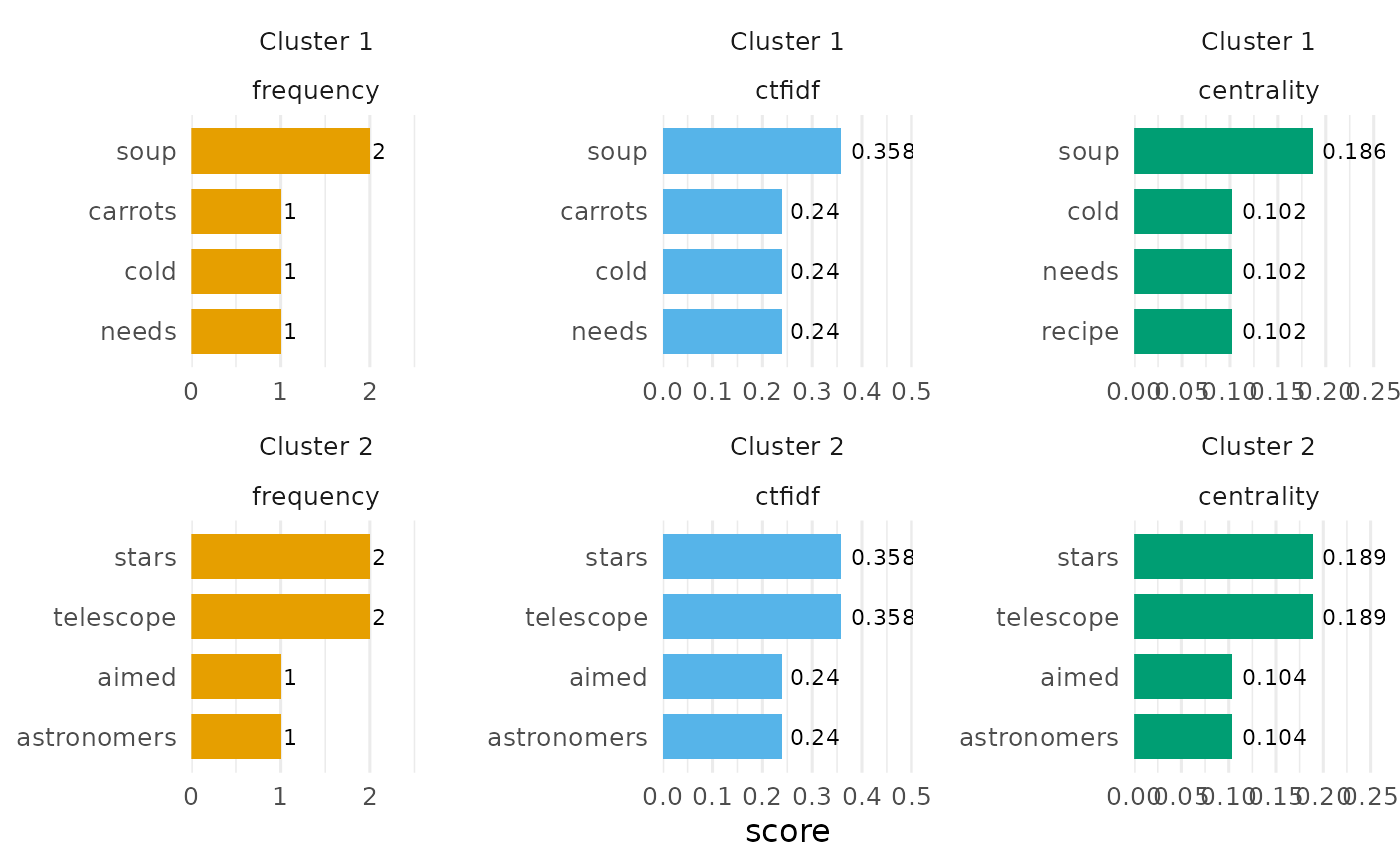
plot() returns a ggplot: one panel per cluster (rows) and score type
(columns), each with its own word axis, horizontal bars of value per
word, Okabe-Ito fill by type. It needs the long form and raises
hypergraphs_bad_input on a collapsed table.
Details
"mass"(default): the summed incidence weight a cluster's documents place on the word (tf-idf mass underweight = "tfidf", counts underweight = "n"). Works on any hypergraph."frequency": the raw token count of the word in the cluster's documents, whatever the incidence weighting."ctfidf": class-based tf-idf (Grootendorst 2022), the topic representation BERTopic uses: the cluster's L1-normalised term frequency timeslog(A / f_w + 1), wheref_wis the word's corpus count andAthe average token count per cluster (truncated to an integer, as in the reference implementation)."centrality": the word's centrality within the cluster's own word hypergraph (words as nodes, the cluster's documents as hyperedges, incidence = the stored weights), fromhg_centrality()with the measure named incentrality.
"frequency", "ctfidf" and "centrality" need the token-level layer
of a bag-of-words document hypergraph (construction = "bag",
nodes = "doc"); other hypergraphs raise hypergraphs_bad_input.
Sentence scope. When hg is a text_hypergraph(construction = "sentence") of the documents, clusters still names documents, and the
scores are computed over the cluster's sentences: two words are then
related by sharing a sentence rather than a document. "mass" and
"frequency" sum the in-sentence counts; "centrality" is the word's
centrality among the cluster's sentence hyperedges.
External scores. scores takes a data.frame with columns node,
word and one numeric column (for instance the attention table from
hg_hypergat(what = "attention")). Its values are summed per cluster
and reported as their own block, labelled by the numeric column's name.
References
Grootendorst, M. (2022). BERTopic: Neural topic modeling with a class-based TF-IDF procedure. arXiv:2203.05794.
Examples
hg <- text_hypergraph(c(
cooking_1 = "simmer the soup with onions and carrots",
cooking_2 = "this soup recipe needs salt on a cold night",
space_1 = "the telescope revealed a distant galaxy and stars",
space_2 = "astronomers aimed the telescope at the stars all night"
), stop_words = c("the", "with", "and", "a", "this", "at", "on", "all"))
topics <- hg_cluster(hg, k = 2, seed = 1)
hg_keywords(hg, topics, n = 3)
#> type cluster size words
#> mass Cluster 1 2 soup, carrots, cold
#> mass Cluster 2 2 stars, telescope, aimed
#> 6 rows in the returned long table (rank, score, share, n_docs)
hg_keywords(hg, topics, n = 3, type = "ctfidf")
#> type cluster size words
#> ctfidf Cluster 1 2 soup, carrots, cold
#> ctfidf Cluster 2 2 stars, telescope, aimed
#> 6 rows in the returned long table (rank, score, share, n_docs)
words <- hg_keywords(hg, topics, n = 4,
type = c("frequency", "ctfidf", "centrality"))
plot(words)
 # distinctive rather than heavy vocabulary: rank by share, with support
hg_keywords(hg, topics, n = 3, sort_by = "share", min_docs = 1)
#> type cluster size words
#> mass Cluster 1 2 soup, carrots, cold
#> mass Cluster 2 2 stars, telescope, aimed
#> 6 rows in the returned long table (rank, score, share, n_docs)
# distinctive rather than heavy vocabulary: rank by share, with support
hg_keywords(hg, topics, n = 3, sort_by = "share", min_docs = 1)
#> type cluster size words
#> mass Cluster 1 2 soup, carrots, cold
#> mass Cluster 2 2 stars, telescope, aimed
#> 6 rows in the returned long table (rank, score, share, n_docs)